
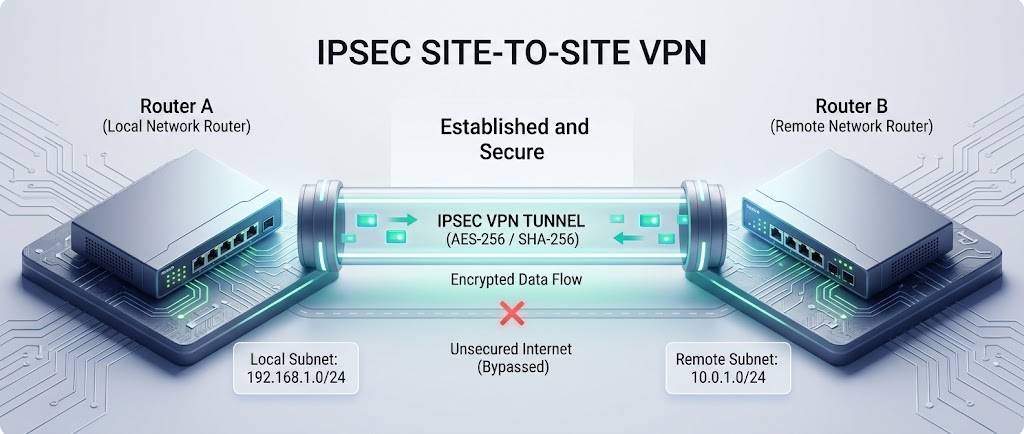
Generate site-to-site IPsec VPN configs for Cisco IOS/IOS-XE, ASA, FortiGate, Palo Alto, Juniper SRX, strongSwan/VyOS, UniFi, and pfSense/OPNsense — for one side or both at once. The real value here is the policy-based ↔ route-based interop case: when one side is policy-based (proxy-ID per subnet pair) and the other is route-based (defaults to a catch-all 0.0.0.0/0 selector), phase 2 negotiation fails unless the route-based side's proxy-IDs/traffic-selectors are narrowed to match the policy-based side's exact subnet pairs. This tool computes that automatically and warns you when it kicks in. Route-based sides also get an auto-computed tunnel MTU and TCP MSS clamping — ESP overhead eating into the path MTU is the other classic way an IPsec tunnel silently breaks large-packet traffic while ping/SSH keep working fine. Everything runs in your browser — nothing is sent anywhere.
How the same AES-256/SHA-256/DH14 proposal is spelled per platform — the single most common source of "phase 1 just won't come up" between two engineers who are actually configuring the same algorithms.
| Concept | Cisco IOS | ASA | FortiGate | Palo Alto | Juniper SRX | strongSwan |
|---|---|---|---|---|---|---|
| AES-256 | aes 256 | aes-256 | aes256 | aes-256-cbc | aes-256-cbc | aes256 |
| SHA-256 | sha256 | sha-256 | sha256 | sha256 | hmac-sha-256-128 | sha256 |
| DH Group 14 | group14 | group14 | 14 | group14 | group14 | modp2048 |
| AES-256-GCM | esp-gcm 256 | aes-gcm-256 | aes256gcm | aes-256-gcm | aes-256-gcm | aes256gcm16 |
Provided as-is, with no warranty of any kind. This generates a starting point, not a certified or vendor-validated configuration — exact syntax, supported algorithms, and defaults can vary by platform and software version. Always read through the generated config line by line, verify it against current vendor documentation and your own environment, and test in a lab before touching production. See the full disclaimer.