
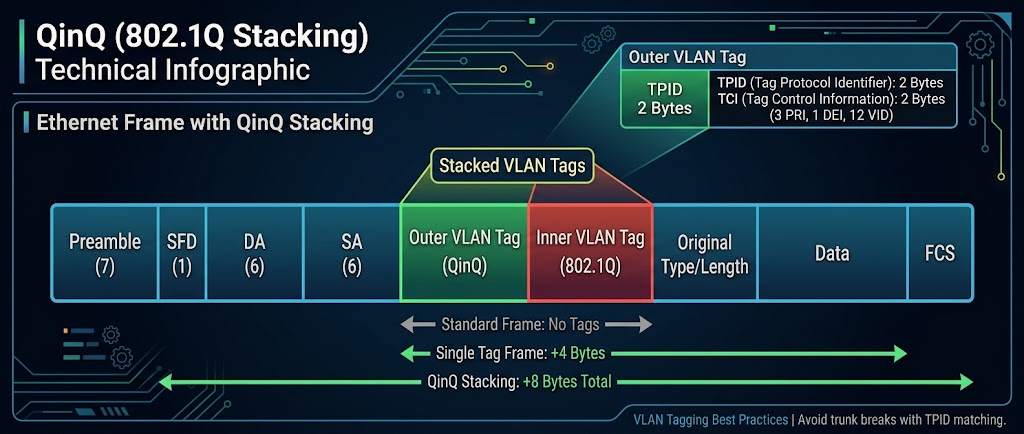
See the exact byte cost of stacking 802.1Q/QinQ VLAN tags, and check whether two vendors will actually interoperate before you build a QinQ trunk between them — the outer tag's EtherType (TPID) is the single most common reason a working single-vendor QinQ link breaks the moment it crosses to a different platform.
mtu is L3-only, but do need to be added to the configured mtu number on platforms where it includes the L2 header. Stacking these tags with a tunnel (GRE/VXLAN/IPsec/etc)? Use the MTU / Encapsulation Overhead Calculator for the full per-platform number.| Platform | Set interface mtu to | Why |
|---|
| Platform | Outer TPID when QinQ-configured | What to configure |
|---|
Sourced from vendor documentation: Cisco IEEE 802.1Q Tunneling config guide, Juniper flexible-vlan-tagging reference, FortiOS QinQ 802.1ad admin guide, Arista dot1q/TPID TOI, and Palo Alto LIVEcommunity threads on QinQ/802.1ad limitations.
Provided as-is, with no warranty of any kind. Exact CLI syntax and default behavior vary by platform family and software version within each vendor (e.g. classic Cisco IOS vs. IOS-XE service-instance config, Junos EX/QFX vs. MX, FortiOS release) — verify against your own gear and current documentation before applying to production. See the full disclaimer.